

At Grant Dale Consulting (GDC) we believe that good decisions are based on sound information. To support individuals, groups and organisations we offer a range of highly respected diagnostics that provide a wealth of insight.
Life Styles Inventory™ (LSI) – 360-degree Feedback
The Life Styles Inventory™ (LSI) helps individuals develop constructive thinking and behavioural styles that are proven to be related to job performance, quality of interpersonal relationships, and problem-solving effectiveness. The LSI is an organisational tool that uses both self-assessment and colleague feedback to identify an individual’s thinking and behavioural styles. By providing insights into their strengths and areas for development, it empowers them to embark on their own journeys to being better at, and enjoying more, everything they do.
Designed for managers, leaders and those in professional and technical roles, the LSI has helped millions of people to understand and change the way they think and behave. It has also received great feedback on LinkedIn, and been referenced in numerous management and psychology books and journals, newspapers and magazines.
(Reference: description sourced with permission from www.human-synergistics.com.au)
Leadership Impact® (L/I)
L/I provides those in leadership positions with unique insights into their leadership strategies and the impact of these on the behaviour and performance of those being led. It is this researched relationship between strategies and behavioural impact that makes L/I quite unique.
(Reference: description sourced with permission from www.human-synergistics.com.au)
Management Impact™ (M/I)
Designed for managers who are responsible for strategy execution, M/I provides the focal manager with feedback from others on how they approach their managerial responsibilities, the impact they have on the behaviours and performance of those around them and how effective they are seen in their managerial role.
(Reference: description sourced with permission from www.human-synergistics.com.au)
Team Simulations
Team Simulations enable teams to:
- learn the interpersonal (people) and rational (task) behaviours consistent with successful teamwork
- demonstrate the positive impact of constructive group styles on team performance
- improve effectiveness of team problem-solving and decision-making skills
- strengthen cooperation and communication among team members
(Reference: description sourced with permission from www.human-synergistics.com.au)

Group Styles Inventory™ (GSI)
When individuals combine and work together effectively, then the outcome is greater than the simple sum of the parts (synergy) and improvement in performance can, and does, occur. The Group Styles Inventory™ (GSI) is a team based measure, which assesses the behaviours observed by team members during a team decision-making session. Each team member completes the inventory and the combined responses represent a clear profile of the behaviours used by the team in its efforts to achieve quality decisions with high acceptance.
The GSI measures the constructive and defensive elements of group processes with the 12 styles used in the Human Synergistics® Circumplex. Certain group styles are productive and lead to high quality decisions to which members are highly committed. Other group styles are counterproductive and lead to solutions of marginal or poor quality and limited group acceptance. Used in conjunction with a group problem-solving simulation, the GSI provides significant practical insight into how a group functions, allowing the group to focus its efforts precisely on where improvement is needed. The GSI may also be used following a real-life situation (eg management meetings), and as an ongoing measure for group performance.
(Reference: description sourced with permission from www.human-synergistics.com.au)
Organisational Culture Inventory® (OCI)
A special version of the OCI is used to create a vision of the ideal or preferred culture for the organisation. Using this, leaders can define the culture that would best help their organisation achieve its vision and support long term effectiveness. This ideal culture profile then becomes the standard against which the actual organisational culture is then compared, resulting in a gap analysis that focuses improvement efforts where they can make the most difference.
(Reference: description sourced with permission from www.human-synergistics.com.au)
Organisational Effectiveness Inventory™ (OEI)
The Organisational Effectiveness Inventory™ (OEI) complements the Organisational Culture Inventory® (OCI) by measuring the Causal Factors (Levers for Change) that shape culture and the outcomes of culture at the individual, group and organisational levels. The OEI provides a research based alternative to employee opinion surveys, linking climate and culture:
- What people experience as members of the organisation
- The impact this has on culture
- How culture in turn impacts important outcomes at the individual level (eg engagement), at the group level (eg teamwork), and at the organisational level (eg adaptability and quality)
This comprehensive process assesses virtually all internal factors and conditions that are likely to impact on your organisation’s performance. Together the OCI and the OEI provide a complete picture of the case for change and the levers for change. With the OCI measuring preferred and actual operating culture, and the OEI measuring organisational practices and outcomes, clear strategies emerge for managing improvement.
(Reference: description sourced with permission from www.human-synergistics.com.au)
Hogan 360
- The Hogan 360 is perfect for leadership development for individuals, teams and high potentials. Anyone looking for improvement opportunities will benefit greatly.
- The Hogan 360 creates self-awareness around strengths to be leveraged and opportunities to be addressed.
- The results are compared to our global database of over 44,000 leaders. The benchmark score is expressed against percentiles from the bottom 10th percentile through to the top 90th percentile.
- Behavioural and business competencies are measured and create sustainable learning and coaching opportunities for the next year.
- The Hogan 360 can improve leadership effectiveness which enhances team performance, employee engagement and organisational results. its, better stock market performance, stronger talent retention and an engaged workforce.
Leadership is concerned with the success of teams, groups, and organisations. Therefore, leadership effectiveness can be measured by how positively a leader’s behaviours and performance are evaluated by those they work with. The multi-rater aspect of the Hogan 360 ensures evaluations are elicited from multiple sources from within the leader’s work circle (e.g., from direct reports, peers, and managers). These diverse perspectives help provide a real-time snapshot of a leader’s attitude, behaviour, and performance, and reveal strengths and development opportunities that may not be seen from a single perspective.
Further, due to the confidential and anonymous nature of the responses, the Hogan 360 allows raters to provide honest feedback that might otherwise be difficult to solicit. The report uses an easy-to-interpret leadership framework, offers constructive feedback and sets priorities for improvement. Therefore, the Hogan 360 aims to help leaders at any level of an organisation gain a better understanding of how they are truly perceived by others and thereby improve their leadership potential.
There are two main benefits of multi-rater feedback tools. As previously mentioned, it provides a measurement of a leader’s effectiveness, and research into multi-rater feedback ratings has demonstrated links to a variety of important organisational outcomes (e.g. profitability, engagement, customer satisfaction).
Second, results from multi-rater feedback tools can provide the foundations for development. The results can help pinpoint the strengths and opportunities, which can then be used to formulate targeted strategies for improvement. It is important to use a multi-rater tool with sound reliability and validity, as well as a consistent and best practice approach to administering the tool.
The Hogan 360 includes:
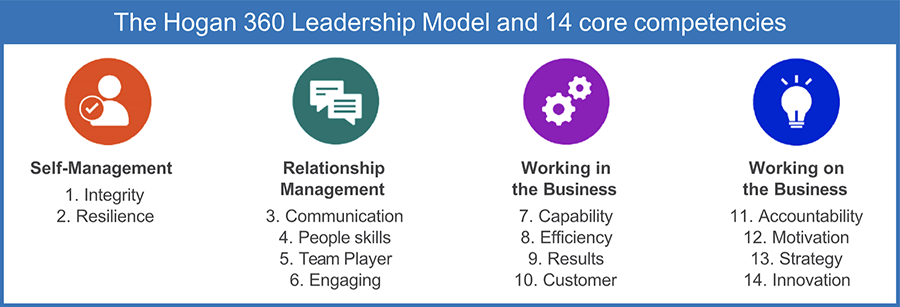
- 50 scaled items (7-point scale) mapped to the four quadrants of the Hogan 360 Leadership Model and their corresponding sub-themes
- Strengths and opportunities tables that identify key strengths and opportunities
- Three open-ended questions focusing on strengths, opportunities, and overused strengths
- Appendices – Frequency tables that enable additional insights into the ratings provided.
The ratee’s overall Hogan 360 score is calculated by averaging all ratings across the 50 items, yielding an overall Hogan 360 score between 1.00 and 7.00. This overall score is compared to a global benchmark sample which is updated annually. The sample is comprised of leaders and executives that represent the international working population across a broad number of industries. The comparison between an individual’s overall score and the benchmark mean yields a percentile ranking that allows leaders to gauge their performance in relation to others around the world.
Further information: glwswellbeing.com
Hogan Personality Inventory (HPI)
Developed specifically for the business community, the HPI predicts the ability to get along and get ahead, which determines success in careers, relationships, education, and life.
The HPI assesses the bright side of personality using seven scales to predict how people behave when they are at their best.
Scales and Definitions
- Adjustment – confidence, self-esteem, composure under pressure
- Ambition – initiative, competitiveness, leadership aspirations
- Sociability – outgoing, approachable, enjoying social interaction
- Interpersonal Sensitivity – warmth, tact, perceptiveness, relationship skills
- Prudence – self-discipline, work ethic, integrity
- Inquisitive – imagination, curiosity, creative potential
- Learning Approach – valuing education, training, and staying current
Assessment Facts
- Predicts the ability to succeed in a particular role or organisation
- 15- to 20-minute completion time
- Instant scoring and reporting output
- Online administration
- No invasive or intrusive items
- Available in 51 languages and dialects
- More than four million participants assessed
- Used in more than 1,500 research studies
- No adverse impact
Organisations around the world rely on the HPI to provide insight into how people will work, how they will lead, and how successful they will be in their careers.
Hogan Development Survey (HDS)
The HDS concerns behavioral tendencies that are strengths under normal circumstances. However, during times of stress or pressure, these behaviors become problematic, degrade leadership effectiveness, and erode the quality of business and personal relationships.
The HDS assesses the dark side of personality using 11 scales that concern how people behave when they stop self-managing.
Scales and Definitions
- Excitable – volatile, easily upset, hard to please
- Sceptical – suspicious, argumentative, vindictive
- Cautious – risk-averse, fearful of failure, criticism, or embarrassment
- Reserved – aloof, blunt, uncommunicative, lacking empathy
- Leisurely – overtly cooperative, covertly irritable, stubborn, procrastinating
- Bold – arrogant, entitled, grandiose
- Mischievous – charming, manipulative, risk- taking, excitement-seeking
- Colorful – dramatic, attention-seeking, disruptive
- Imaginative – creative, eccentric
- Diligent – hardworking, meticulous, critical, controlling
- Dutiful – eager to please authority, unconcerned about subordinates, socially appropriate
Assessment Facts
- Identifies problematic behavioral tendencies not detected in an interview
- 15- to 20-minute completion time
- Online administration
- Instant scoring and reporting output
- No invasive or intrusive items
- Available in 47 languages and dialects
- Nearly three million participants assessed
- Used in more than 1,000 research studies
- No adverse impact
Organisations around the world rely on the HDS to identify derailers that disrupt or interfere with effective performance.
Motives, Values, Preferences Inventory (MVPI)
The MVPI concerns personal values, motives, and unconscious biases.
The MVPI assesses the inside of personality using 10 scales that concern core values, which are often unconscious but determine career satisfaction
Scales and Definitions
- Recognition – wanting attention, visibility, status
- Power – wanting success and the control of resources
- Hedonism – seeking fun, pleasure, enjoyment
- Altruistic – wanting to help the less fortunate, contribute to society
- Affiliation – needing opportunities for networking and interaction
- Tradition – valuing established principles of conduct and belief
- Security – wanting structure, order, predictability
- Commerce – seeking symbols of material success
- Aesthetics – concerned with creativity, good design, self-expression
- Science – seeking data-based solutions to important problems
Assessment Facts
- Evaluates the alignment between personal values and organisational culture
- 15- to 20-minute completion time
- Online administration
- Instant scoring and reporting output
- No invasive or intrusive items
- Available in 47 languages and dialects
- More than two million participants assessed
- Used in more than 600 research studies
- No adverse impact
Organisations around the world use the MVPI to evaluate the alignment between individuals and work environments, which is critical for engagement and productivity.